
Touch Plane
On Orford Ness, and shaping Britain's nuclear imagination

Our favourite family day out is the RAF Museum in Hendon. Just a twenty-minute drive up the Finchley Road is a lovingly curated array of the world’s most lethal machinery, a café, and a playground, all for free. It’s hard to predict children’s first memories, but if I had to place a bet on our two-year-old Henry’s, it’s probably the moment he first touched the Vulcan bomber in Hangar H3. The megaton-capable nuclear bomber, comfortably his favourite plane, hums with lethal energy, facing the corner of the shed like a naughty schoolchild from the olden days: Just William, if he’d jauntily turned Moscow to glass on a whim. Once or twice a day, even now, he’ll suddenly remember the encounter and mutter the same two words: ‘touch plane.’
A strange thing has happened with many of the agents of our nuclear annihilation: we have, somehow, come to love them. I remember visiting a nuclear bunker north of St Andrews as a child, joining a stream of underground pilgrims all eager to experience ‘Scotland’s most exciting visitor attraction.’ And at university, walking into the common room to find it commandeered for a screening of Threads, the 1984 BBC shit-scarer in which Sheffield is bombed back to the Middle Ages.
Among Britain’s nuclear artefacts, one stands above all others: Orford Ness, a ten-mile spit of shingle and rusted metal south of Aldeburgh. For the second half of the twentieth century it served as the proving ground for the nation’s comically named nuclear weapons — Blue Danube, Yellow Sun, Green Grass, Red Snow. Given its past, you might expect revulsion any time a visitor steps onto this strange bit of shoreline. Yet it has quietly become one of Britain’s most beloved locations.
The oft-cited moment of the Ness’s canonisation came in 1992, when W. G. Sebald, walking the Suffolk coastline, took the ferry over to the abandoned site. His brief passage about it in The Rings of Saturn (1995) is probably the closest thing the Ness has to a founding scripture: ‘The closer I came to these ruins, the more any notion of a mysterious isle of the dead receded, and the more I imagined myself amidst the remains of our own civilisation after its extinction in some future catastrophe… Where and in what time I truly was that day at Orford Ness I cannot say, even now as I write these words.’
With this moment of first contact, or so the story goes, the Ness was anointed. Sebald’s pilgrimage, together with the site’s general air of numinosity, has fated it ever since to be a sanctuary-cum-muse for Britain’s artists and writers. In 2012 one blogger described the Ness as ‘a kind of Tintern Abbey for the post-industrial Romantic.’ In a 2019 interview with Granta, Robert Macfarlane, the closest thing to a keeper of Sebald’s flame, went even further: ‘the Ness is atomic pastoral, a shattered sacrificial-ceremonial supermodern Stonehenge, a ritual space.’
Anyone who has taken the ferry over to the Ness will recognise the distinct feeling that pulls us towards such sites. It is the grown-up version of Henry’s ever-present desire to ‘touch plane.’ Whether it comes from some buried prey impulse or from our unresolved awe at the fact that humans can possess this kind of power is almost irrelevant; the feeling is simply there, and it stays with us. Yet this truth, along with the happy accident of Sebald’s wanderings, often leads us to think it was always going to be this way: that Britain’s cultural left would always find their way to the Ness as if its ruinous charms were somehow inevitable. They weren’t.
Long before the Ministry of Defence acquired the land in the 1910s, Orford Ness had a touch of strangeness about it. In the twelfth century local fishermen supposedly caught a merman in their nets, whom the authorities briefly tortured before he slipped back to the sea. In the eighteenth century there were reports of a gigantic winged crocodile prowling the waters off the spit. When the MoD finally arrived, the rumours continued, though now with a slightly more earthly tinge.
In the 1930s it became one of Britain’s first radar development stations. After the war it passed quietly into the hands of the Atomic Weapons Establishment, the agency responsible for designing and maintaining the UK’s nuclear arsenal, which used it to trial key components of the British bomb: high-explosive lenses, electronic triggers and environmental stress systems. In the 1960s it also became home to Cobra Mist, an experimental over-the-horizon radar system that never quite worked for reasons no one has ever convincingly explained.
By 1993, when the National Trust acquired the site, those days were long past. Abandoned in the 1980s, the Ness had become a ruin in which the animals and birds that relied on its shingle, saltmarshes and stagnant lagoons butted heads with petty vandals, traffickers and drug smugglers bringing their product across from Antwerp and Rotterdam. Locally it was known as ‘Awful Mess,’ though the regulars of the pub opposite the Ness, the Jolly Sailor, presumably enjoyed the vast quantities of Dutch tobacco they were given as encouragement to keep quiet. A recorded interview with the first area manager recounts police Land Rovers racing across the dunes, the discovery of fifty kilograms of cannabis stashed on the beach, and threats from an organised crime group after he accidentally exposed a hare-coursing ring.
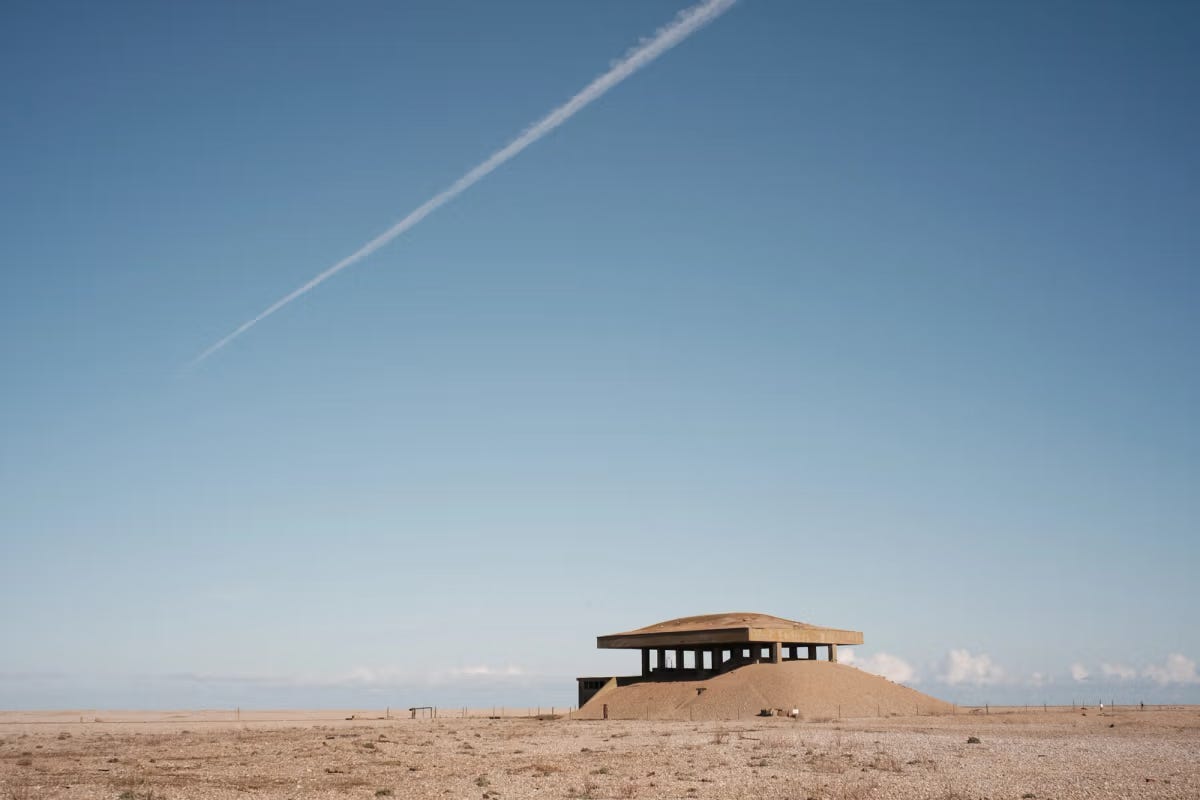
The site also came with a larger problem: what to do with the sixty or so testing vaults and ruined buildings that littered the shoreline, most notably the two strange concrete ‘pagodas’ - hardened concrete structures designed specifically to contain any accidental explosion that occurred whilst testing, looking more like a Neolithic take on a Han dynasty temple than any building in the contemporary imagination.
The obvious solution was to knock them down and turn the Ness into a nature reserve. It is the best-preserved shingle ridge in Europe, holding fifteen per cent of the world’s vegetated shingle and home to breeding avocets and lapwing, marsh harriers, and even a suite of nationally rare spiders, including the tiny jumping spider Neon pictus.
Yet others in the organisation thought otherwise. The National Trust already preserves the ruins of other centuries; why should the twentieth be treated any differently? Rather than smoothing out the site’s contradictions, they argued, the Trust should lean into them, even sharpen them. As Christoph Waltz said last week, paraphrasing Hegel while discussing ceviche, there can never be a whole without the contradiction. It is a line the architects, historians and managers tasked with the original site plan would have happily nodded along to as they set about designing their own North Sea dialectic.
The result was a plan to operate the Ness in a spirit of ‘controlled ruination,’ in which most of the island’s structures would be left to collapse naturally. Alongside this came two guiding principles. The first was that Orford Ness should be a ‘safe but not comfortable’ visit. The second was that you may not be the only person on the site, but you should always be able to feel as if you are.
Hence the Ness as it exists today for the roughly eight thousand visitors who arrive each year via Octavia, the Trust’s small ferry that carries twelve people at a time across the River Alde. Because of the lingering risk of unexploded ordnance, you cannot wander freely but must follow a marked trail. After several miles of trudging through the shingle you pass the Black Beacon — a slatted lighthouse with its top lopped off, once home to one of the earliest radio-navigation systems — and eventually reach the atomic weapons area, the Pagodas faintly pulsing in the distance.
Then you turn around and walk back to the ferry, pausing once or twice to take in whatever caught your attention on the way out. For me it is the atomic bomb that sits in one of the information huts. Acquired in 2004 after three years of negotiation, it is a WE177A, the UK’s workhorse tactical and strategic nuclear weapon until the shift to a sea-only deterrent. If, as hinted in the most recent Strategic Defence Review, Britain does eventually restore some form of air-delivered capability, it will be the lineal descendant of weapons like this that end up inside an F-35A. The Trust’s WE177A is, I think, the only intact example on public display in the country.
In a world of infinite distribution, retaining such a mystique requires something more imaginative than leaving leaflets in holiday cottages. In the years before the Ness opened to visitors, it became clear that the Trust, an institution more versed in the aesthetics of 1930s railway postcards than the post-apocalyptic sublime, would need some help. So they called on the artist Dennis Creffield, promptly dispatching him to the abandoned Ness, where he camped in a wooden hut and rose each morning to paint the landscape. It is lost to history how many surprised Dutch drug smugglers Creffield encountered at his easel, but the paintings remain, and still colour the Trust’s depictions of the Ness today.
Where Creffield went, many more have followed. For decades artists, writers and musicians have been invited to the Ness with a level of freedom, access and institutional indulgence that is almost certainly unique within the Trust. In 2005 Louise Wilson was invited to collect and manipulate sound recordings from across the shingle, which were then played inside the Black Beacon. In 2012 Robert Macfarlane, along with jazz musician Arnie Somogyi, were given e-bikes, an ageing Land Rover and an off-limits access pass to plan a performance in the New Armoury Building. And this summer eleven artists were each given three weeks in a makeshift on-site studio.
All of this points to a simple truth: the Ness did not become beloved by accident. Its aura is not inevitability but an achievement, deliberately assembled through decades of choices. And this matters, because the real brake on nuclear power in this country has never been technological, but imaginative.
What makes nuclear technology, and nuclear energy in particular, such an outlier is that it remains one of the few general-purpose technologies with a distinctly national character. Computers, modern medicine and the internet have converged into broadly shared forms across the West: a laptop is a laptop, an MRI scanner an MRI scanner, and most people in Britain, France or the United States intuitively imagine them doing the same things for the same reasons. Nuclear power, by contrast, is still filtered through sharply divergent national stories.
France built an aesthetic of radiance and technological confidence, and from it constructed a grid that is 60 to 80 per cent nuclear at any given moment, powered by a fleet of fifty-seven reactors. Ireland, by contrast, treats nuclear as a dread taboo. Its closest analogue to Threads is Fallout (2008), a docudrama imagining an accident at Sellafield — a site that, by that point, produced no electricity at all — triggering mass looting within hours, the collapse of the Irish state within days, and the depopulation of western Ireland by the end of the month.
Britain sits uneasily somewhere in between, with a nuclear culture best described as neurotic: never anti-nuclear as such, just permanently anxious about it. In the 1980s this anxiety produced its most memorable expression: a televised demonstration of nuclear-waste flask safety in which a runaway train was sent hurtling at more than 100 miles an hour into a derailed wagon, before an invited audience of 1,500 guests seated in a grandstand and served fish and chips, politely applauding as the locomotive folded into twisted, burning metal on a test track in the Midlands. Today the same unease expresses itself in the laughably slow, finicky regulatory process that dogs any new nuclear project. Lord, give me nukes, but not yet.
Thus, I think the National Trust at Orford Ness may have stumbled upon an unintentional blueprint: a way of telling the nuclear story that fits more naturally with the British imagination. Embrace the contradictions rather than deny them, spare us the rictus grin at the despatch box, and let the strangeness speak for itself. The Trust’s focus has, for obvious reasons, been on Britain’s nuclear past. But why shouldn’t the same aesthetic apply to Britain’s nuclear future?
Such an approach has a longer pedigree than one might imagine. Many of the other sites in the Trust’s portfolio were themselves the spoils of uneasy victors in the European wars of the long eighteenth century. Too awkward, or too constrained, to build the monumental houses they felt were expected of them, many landowners reached for an alternative aesthetic: they built ruins instead. The follies of the Romantic and gothic imagination, from the ruined castle at Dinefwr to the mock temples of Stourhead, now stewarded by the Trust, are far closer to Orford Ness in spirit than we tend to realise.
Perhaps this is the aesthetic to which the next generation of nuclear power should aspire: not beautifully designed structures, but ruins from the outset, with the same acceptance the Ness teaches us — that Britain simply cannot build its monuments straight. Build the thing that looks slightly wrong, not just because it will be faster and cheaper, but because it will feel truer as well. Do that, and you tap directly into one of the deepest parts of the British operating system. From the seventeenth-century antiquarians who obsessed over Stonehenge and Avebury to the politicians of the 1990s who chose to build their monument to the millennium on a toxic disused limeworks in Greenwich, we go wild for a ruin.
And so, when the next history of British nuclear power is written, its most consequential moment may not be the development of the Magnox reactor in 1956, or the completion of the first PWR2 in 1985. It may instead turn out to be the decision by a handful of conservationists to turn one of Britain’s most foreboding nuclear sites into a place that can genuinely be loved. If institutions can choreograph tenderness for a decaying bomb lab, then it becomes easier to feel a little more optimistic about our ability to do the same for the future machines that will one day power this island.
In the end, politics will obey the feeling. And so, like the stewards of the Ness, that is where we should begin: with the small, childlike impulse to step closer and touch the plane.
Love this!