
Rumer has it
On Rumer Godden, Black Narcissus, and crises of faith

Hi everyone,
Hope all’s well, and apologies for the gap in programming.
I’ve got quite a bit of new writing to share this week: on Saturday I was in the Ruffian making the case for bad behaviour as fundamental to intellectual life; and yesterday, in the New Statesman, on 28 Years Later, and the return of the English strange.
This month I’m also in the London Magazine, writing about the time New Labour invited Cameron Mackintosh, Richard Curtis and Stephen Spielberg to 10 Downing Street, and the show the trio came up with.
Today I thought I’d share something about an old favourite: Rumer Godden.
Thanks as ever, for reading,
Aled
When Martin Scorsese talks of films, only a few get the top shelf treatment. It’s not always clear what’s required to earn his admiration: try to draw a link between Ugetsu and Ashes and Diamonds, and you’ll likely come up blank. A few common threads do, however, recur when you press your finger into his lifelong Anglophilia. One is his obsession with the films of Michael Powell and Emeric Pressburger. The other, with the screenplays and adaptations of novels by Rumer Godden.
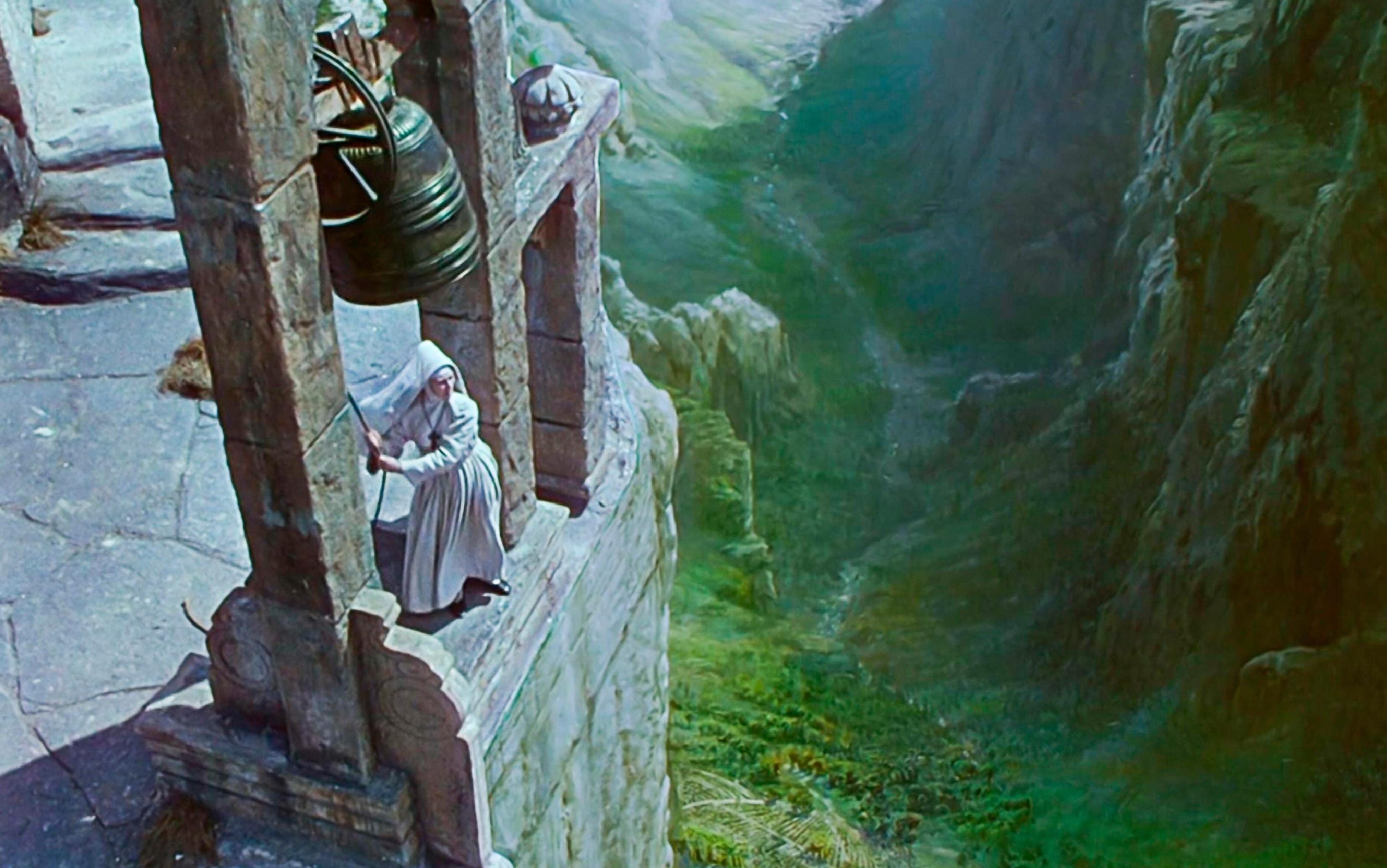
There are two Godden adaptations in particular to which Marty keeps returning. The first is Powell and Pressburger’s 1947 psychological horror Black Narcissus. A band of nuns are sent to a mountain-top palace called Mopu in the Himalayan foothills, tasked with setting up a convent. The enormity of both their endeavour and their surroundings slowly but surely drives each nun mad. The second, Jean Renoir’s The River, came out four years later. It’s a coming of age classic, told from the perspective of a girl, who – like Godden – spent her childhood on the banks of the Bengal river. Marty saw it when he was nine. Later he would call it one of the most formative film experiences of his life.
It is rare for anyone to remember Godden at all. Go to the National Trust website for the house she worked from for much of her later life, Lamb House in Rye, and you’ll find her pipped to top billing by a more illustrious previous resident: Henry James. Fair enough. The second name is not hers, but E.F Benson. Reader, I’m going to confess I’d never heard of him. You have to do a bit more clicking around to finally find a mention of Godden who, in exchange for a cheaper rent, agreed to show any travelling Jamesians around once a week.
Born in Eastbourne in 1907, and shipped to India at six months old, Godden was the Raj orphan who wasn’t. The First World War dissuaded her parents from sending her back to England for fostering and boarding, so she grew up in Narayanganj, a town in what is now Bangladesh. After a brief spell back in England, she returned to India, set up a dance school in Calcutta, and began to write. Black Narcissus, published in 1939, was her first novel, followed by another sixty books written over the next forty years.
The great creative period of her life was comfortably her unhappiest. Her first husband ran up debts, saddled her with most of them, and left. During World War II she retreated to India: a broke single mother, settling with her two daughters in a tiny cottage next to a lake in Kashmir. Soon after they arrived, the cook began to poison them, each day slipping opium, marijuana and eventually powdered glass into their food. Surviving this, she returned to England, married a civil servant (‘a nice, ugly man’ who would ‘do anything for me’ - a compliment I’d probably take) and settled into a rather disciplinarian writing career, in which she would alternate between novels and children’s books.
Godden’s great obsession was faith in times of crisis. We rarely meet her characters at their lowest ebb. Instead their faith is so full, it runneth over. In Black Narcissus, Sister Clodagh, leader of the nuns of Mopu, is confident of her abilities to shepherd her flock both wisely and well. In the River, twelve year old Harriet holds her belief that she can remain forever in the idyll of childhood so tightly, you almost believe she’s right. In In This House of Brede, Philippa Talbot, a senior civil servant about to take the veil, is almost giddily strident in giving away her earthly belongings to whoever will take them.
Then, with a flick of casual cruelty, the author takes it away. Sometimes it’s a death in the family. Other times it’s a lost love. Sometimes, as in Narcissus, it’s simply a move to new digs. A string is untuned, and away we go.
In Mopu the madness seeps in slowly, through ‘flimsy walls,’ and ‘thickets of silence,’ a place in which through ‘every crack the smell of the world crept in.’ The stolid Sister Philippa turns her garden of food into one of frivolity. Sister Honey starts fixating on the young children she’s tasked with treating. For Sister Ruth, it’s the swarthy local agent, Mr Dean, with his short shorts and never knowingly buttoned up shirt. ‘There’s something in the atmosphere that makes everything seem exaggerated,’ Mr Dean warns the nuns about halfway through the book, unfortunately far too late: the thin air and the sublime surroundings have already taken their grip.
True to how these things usually happen in real life, her characters’ trials are sneak attacks: against not the spiritual, but the temporal self first. In Narcissus Sister Clodagh returns to memories of a lost love, the event that triggered her to don the habit all those years before. ‘The first day I came I thought of him, the first time in years,’ she confides to Sister Philippa. Philippa blames Kanchenjunga, the mountain next door: next to something so old and timeless, what else is there to do but become time-struck? ‘He’s everywhere; before and about and in our house.’
In This House of Brede turns things up to eleven, with a narrative structure much closer that of Infinite Jest than one might expect. As soon as Phillippa Talbot enters the convent, time stops working in the conventional way. All we get is moment after moment of Sister Philippa’s life in the Abbey, structured according to the liturgical year. By the end we’re close to figuring out why Philippa took her vows. It’s the same thing that drove the other inhabitants of Brede Abbey to swap in their own secular lives for an eternal search for, as Augustine once put it: ‘the today which does not yield place to any tomorrow or follow up upon any yesterday.’
How should we respond to such moments – when an imperfect reality fails to align with perfectly laid plans? Godden helpfully gets one of the characters to just say it out loud, good and early. ‘There are only two ways to live in this palace,’ says the ever quotable Sister Philippa, ‘either ignore it completely, or give yourself up to it.’ Stick to the harbour, or ride out the storm. The destination, for the storm riders, is almost always humility: Sister Clodagh accepts her demotion at the end of Narcissus with a chastened sangfroid; Harriet understands what is lost, yet recommits herself to the river. Those who cling on are usually dashed.
In the years directly after Narcissus, her star rose. ‘A fine artist, one of the most accomplished of living English novelists,’ one reviewer wrote in 1952. Forty or so books later, all but the greatest diehards were burned out. Even Carlo Gebler, in a sympathetic review from 2000, found himself admitting ‘I cannot imagine she would find a publisher if she were starting out today.’
Today she finds favour with only three groups. There are the spiritualists drawn to the Catholic tinge of her later works (she converted at the age of sixty one); the children’s authors who still channel her (Godden’s greatest, and perhaps most devoted convert, is Jaqueline Wilson); and then, thanks in some part to Scorsese himself, the film-makers. For the rest of us, her stories of faith and salvation seem just a little dated, belonging to a lost world, swollen with faith, ever ready to be questioned.
While Godden remains very much out of favour, the narratives she loved the most: of ego against duty, certainty against humility, of what is demanded against what we want for ourselves – do seem to be making a comeback. In Wake Up Dead Man, it’s not so much the crime that Rian Johnson wants to draw our attention to, as the crisis of faith it precipitates. Conclave, the last Best Picture winner at the Oscars, is so on the nose I’m vaguely embarrassed to mention it. Godden would have dearly, dearly, wished, I think, to have written the Testament of Anne Lee.
But such crises of faith no longer need to be spiritual in nature. As the man who wrote In This House of Brede’s narrative successor once put it: everybody worships. Perhaps my favourite TV show this year, Marvel’s surprisingly auteur-y Wonder Man, is the perfect study of an actor’s faltering faith in himself. He is driven mad not by the surroundings of Brede or Mopu, but the self-tape booths and smoky elote bowls of Hollywood. The lesson learned – to bend, not break – is the same too. The teacher is not God, but Ben Kingsley merrily playing a washed up thesp from Liverpool . ‘Get out of your head, stop processing, start enjoying,’ he extols to his faltering protege. Follow the ride, and you’ll probably be alright.
I suspect we’ll see more of this over the next few years, as crises of faith move from exception to rule. The story of the day for those who use our heads to put food on the table is that we are now on borrowed time. Give it eighteen months and we’ll all be subsisting off some combination of Substack posting and manual labour, or simply consigning ourselves and our progeny to a life within the ‘permanent underclass.’ On an even bigger canvas: that’s a nicely curated international world order you had there for the last thirty years. Shame if something happened to it.
In such a world the risk, Godden reminds us, is not usually the lack of a sense of direction, but rather too much. Sister Clodagh and Sister Ruth face the same wind, the same mountain, the same memories, and the same man. Yet one is able to sit with the difficulties of life with mystery. The other becomes, for lack of a better word, a doomer: someone for whom every strange development is merely further proof that catastrophe is inevitable. She’s certain she knows how the story ends. Why not get there faster?
Yet if you feel like you have the answer, Godden would say, you’re yet to ask the right question. As her often quite steely novels show, this is not as comforting as it might at first sound. There are no intellectual or spiritual shortcuts.
Halfway through Narcissus, the heir of Mopu palace decides to turn the tables, and tell the nuns a few truths. He starts with the most fundamental: ‘You have to be very strong to live close to God or a mountain, or you’ll turn a little mad.’ We might not live near God, but most of us now live within sight of a mountain. And so, as all of us try and fail, each in our own way, to will the world towards our own specifications, the ultimate seller of stories of contingencies may once again find herself with interested buyers.
Don’t know if you listen to Nina Power’s film podcast but she had a great recent episode on Black Narcissus. Now feeling I really should watch it!