
Resist Closure
On M. John Harrison, The Course of the Heart, and why British politics needs the strange

Whilst at university, whenever I needed to stay in London, I relied on a rather cushy deal I had with a club in Whitehall. It was called the Farmer’s Club. I paid around £80 a year for a vague sort of junior membership. In exchange, they let me stay, from time to time, in their tiniest room at the top of the building, permanently shrouded in cellophane sheets. Once, after leaving the room and finding the main lift was out, I found the service elevator, and took it instead.
The door opened, not to the lobby I was expecting, but to an entirely different space. The feel was similar: beige paint, overly polished wooden doors, and a carpet from the eighties that somehow evoked both Princess Diana and Little Chef. In this world, however, words and numbers had ceased to exist. The sign in front of me had only what I could best describe as painted golden hieroglyphs etched into it, accompanied by a few arrows.
I chose a direction and walked until I reached an open doorway, with a large pyramid sitting on top of the frame. It bore a hieroglyph too, the largest of them all: the head of a fork, its central tine elongated like a middle finger, bisected by a cross, with a sharp triangle jutting from the lower right leg. The room beyond was perfunctory, if dated. A few screens. A few monitors. The same Princess Diana x Olympic Breakfast carpet. It was empty. I bolted. A few turns down corridors, and somehow I was outside, gulping Whitehall’s dirty air.
In the years that followed, I often thought back to this incident, unsure whether it had really happened. A few times I tried to find my way back, but I never could. My best guess was that there was an office next door owned by some kind of magicians’ guild, but a search on Google turned up nothing. Over time, the uncertainty became oddly comforting. A memory, or not-memory, to noodle on while driving down some long stretch of motorway.
In time, I learned the truth. I won’t say how. Only that, in a 19th-century building less than 200 metres from the Ministry of Defence, there is a room that speaks only in symbols. The occult still lives, happily, in the heart of Westminster.
Once, a flirtation with the strange was a rite of passage for high office. Arthur Balfour kept, until his death, automatic writings he believed came from May Lyttelton, his first love, who had died at 25. In an 1894 speech, Lord Salisbury proclaimed: ‘we live in a small, bright oasis… surrounded… by a vast, unexplored region of impenetrable mystery.’ Even in the 1980s, Margaret Thatcher and her colleagues paid their dues. Michael Heseltine built a druidic circle in his garden. Alan Clark hosted the cast of The Tripods at Saltwood. Thatcher herself welcomed a barefoot Indian mystic into her Commons office to have her future foretold.
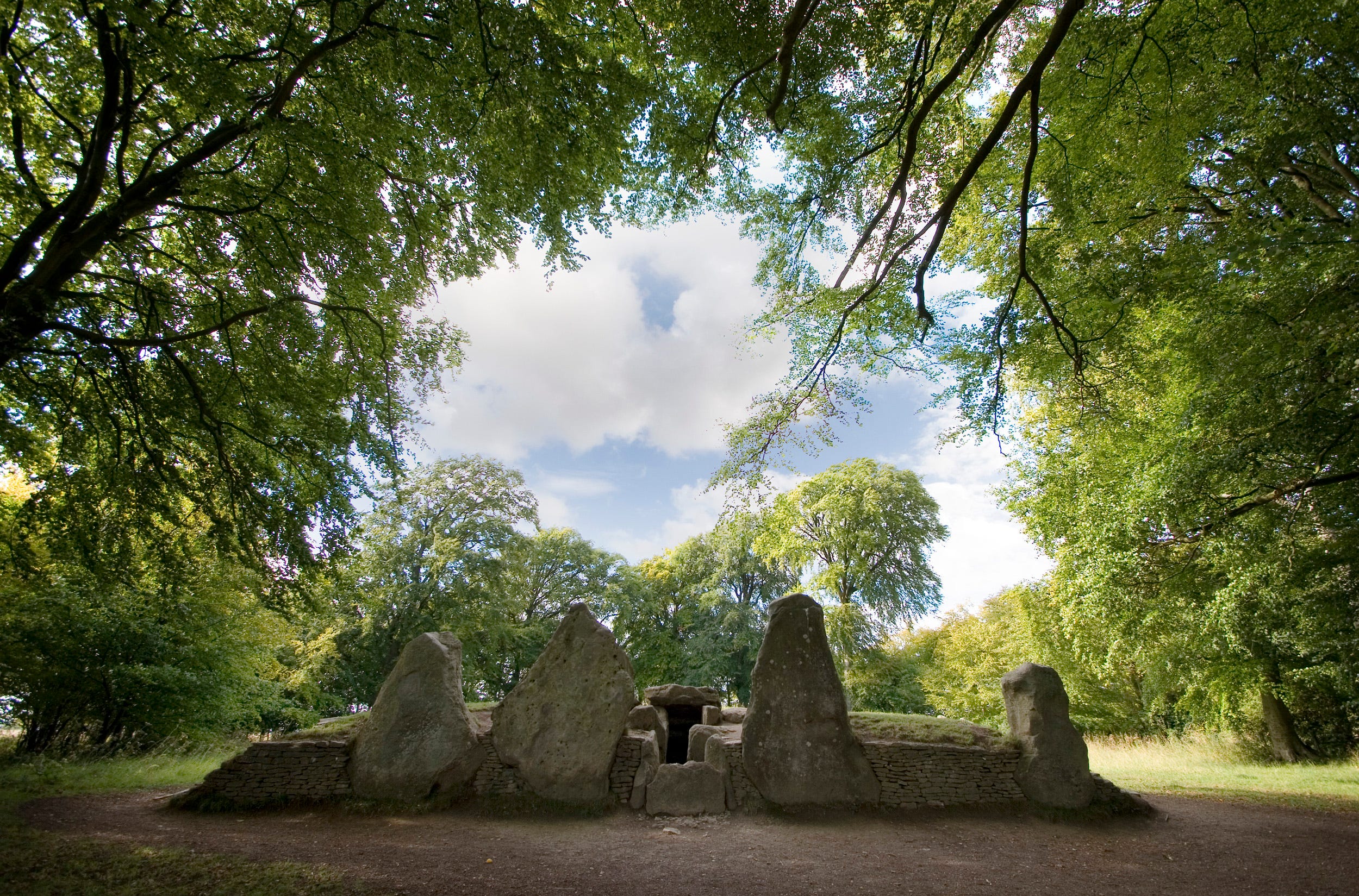
Now, ‘weird’ has shifted from an essential attribute to the most grievous of political insults. The most notorious poster of the 1997 election showed Tony Blair with his eyes replaced by those of a demon — like the children of Midwich, his true nature supposedly revealed in his gaze. Two years later, Blair himself opened his 1999 conference speech with the dig: ‘Under John Major, it was weak, weak, weak. Under William Hague, it’s weird, weird, weird.’ Fifteen years later Ed Miliband, of limestone monoliths and mis-eaten sandwiches, found himself with the same target on his back. Today’s leaders reach for reason above all else. The adults, we are repeatedly told, are back in the room.
Britain’s strangeness is a nettle. You can tramp it down, cut it, punish it. But it just won’t go away. Now, perhaps, it’s resurgent. Weird walks and visits to megaliths are hot in a way that would make Stukeley blush. The most anticipated new British game this year is set in a village named after John Wyndham. The most successful film of the year mashes together visions of St Cuthbert with a hauntological band of Ken Loach cosplayers. When our women’s football team wins an international tournament, players speak of their English blood.
Writers have historically done most to keep the weird flame alive. They train us from an early age: the books young British readers grow up on are almost all fantastical. The impulse runs so deep that to describe, say, the Harry Potter series, seven volumes of wizards and magic, as ‘fantasy’ would, in Britain, mark you out as a bit odd. The instinct persists into adulthood: in the last major national reading survey, seven of the top ten books were science fiction or fantasy. That’s not counting Jane Eyre, a novel whose plot hinges on a moment of horny 19th-century telepathy, which perhaps says it all.
A tradition needs more than reach; it needs depth: writers who embody the sensibility instinctively — the hardcore beneath the literary tarmac. If I had to name one, it would be M. John Harrison.
It’s hard to call Harrison a cult writer any more. Since his debut, apocalyptic shit-scarer The Committed Men (1971), he has spent half a century as our cartographer of the English strange. His most recent novel, The Sunken Land Begins to Rise Again, won the Goldsmiths Prize in 2020. The Course of the Heart (1992), perhaps his strangest novel, has now been reissued.
Three students head into the fields of Cambridge with a haphazard occultist, somewhere between Aleister Crowley and Super Hans. Something occurs, though we are never told exactly what. We only know it takes them near, perhaps even into, the pleroma: a zone outside our world and beyond understanding. From then on their lives are changed. Two are broken, haunted not only by metaphorical spectres, but actual ones. One is trailed everywhere by a pair of entwined ghosts, the other forced into periodic skirmishes with a coke-can-lobbing gnome.
The narrator seems to have fared a little better. His life holds together: a wife and child, a job in publishing, a house overlooking Regent’s Canal. His visions, too, are gentler, more Chelsea Flower Show than Wicker Man: dog and guelder-rose, streaming willows in winter sun, and the smell of attar. When another character tells him, ‘you fell in the shit and came up smelling of flowers,’ he is right in more ways than he realises.
Harrison’s horror is brutally realistic. One character dies choking on half a Mars bar; another by driving a milk float into a ditch. The most chilling passages are the blow-by-blow details of a cancer death. It reminded me of a Saturday Night Live sketch where the Rock plays a mad scientist competing to design the world’s most evil invention. Going third, he promptly kills the contest by unveiling a robot built to molest children. ‘We know what evil means!’ ‘Well, doesn’t seem like you do ‘cause you built a freeze ray.’
His zones are not those of Tarkovsky, nor the family-friendly ‘multiverses’ we know from Marvel films, but those of an England we recognise all too well: a grotty flat in Peckham, a public toilet in Cambridge, the gap in a wedding marquee where the flooring meets the grass.
These settings are familiar from two of Harrison’s other novels, that, along with The Course of the Heart, feel like an unspoken trilogy. The first, Climbers (1989), follows a drifter who, after personal tragedy, devotes himself to the crags and slabs of the Peak District. In the second, The Sunken Land Begins to Rise Again, two characters stumble through a Britain being quietly overrun by fish people.
All three share the same backdrop: an England a click or two removed from our own. In Climbers, Hadrian’s Wall ‘dreaming in the wind and sunshine’ coexists alongside car-parks to nowhere, their bins overflowing with wine bottles and disposable nappies. In Sunken Land, it’s towns on the ‘brown edge of Wales,’ where faded closure notices rub shoulders with dark deeds in the alleys between Costa and My Little Wedding. The Course of the Heart becomes a kind of grand tour: from the grimy Morecambe seafront, through the Pizza Express on Dean Street, all the way to Cornwall’s most notorious dogging spots.
It’s through this world that Harrison’s characters drift, shrug and avoid. When one discovers his family has been destroyed, the response is laconic: ‘the goddess gives. The goddess takes away.’ Another arranges a reunion with his ex-wife in a railway-station restaurant, sits out of sight, watches her for an hour, then boards the train home. The last words of one of the protagonists in Sunken Land, who by my count has seen at least four aquatic humanoids first-hand, are as understated as they come: ‘It’s a nice little town, but something is happening here.’
And when it ends, as it always does, there are no answers. This is the rule Harrison obsesses over most, and the one his readers take to heart: resist closure. We never learn where the water people came from, what the students did with Yaxley, or why white rose petals drift from the sky outside a grotty pub in Settle. Why should we? Who wants Children of Men with a thirty-minute lecture on infertility, or a Twin Peaks in which we watch the interior designers come in to stage the Red Room first? Harrison’s animus towards explicability is clearest in his 2023 ‘anti-memoir,’ Wish I Was Here: ‘Rationale is always the sound of the stuffing falling out, the jaw jaw jaw of a nauseating lack of imaginative intensity.’
All this helps explain the paradox of Harrison. He has his signatures: the grubby beauty of the English countryside, the anticipatory tension of a communal stairway, the uncanny glare of fishbones left on the side of a plate. His themes — uncertainty, obsession, the perils of an imagined past — are hardly unique among contemporary British writers. Yet why does he feel so much more relevant, more attuned to the present, than writers born decades later?
The first reason is obvious. Most literary novelists have to think their way into the strange: they start with a conceit, wrestle their way out of the rationalist trap, and only then invite us in — having overcome what Ishiguro, speaking of himself, once called the ‘instinctive suspicion’ that colours such attempts. Harrison’s approach is different. Others put on the fantastical. He embodied it from the start.
The second reason is that the world has bent back towards his way of thinking. The nettle has regrown. The Course of the Heart ends with the fall of the Berlin Wall, ‘then came the fireworks at the Brandenburg Gate,’ while Sunken Land brings us to an England unknowingly on the verge of the pandemic. The thirty-year gap between the two mirrors our own interregnum: the calmer, cleverer, teleological world that followed Demon Eyes, a world that now looks like an aberration. ‘The shiny offered produce of a vanished age,’ as one character in Sunken Land puts it, gazing at glossy printing paper in a run-down regional shop. If this world and that of The Course of the Heart feel similar, it is because they are. Push the land down deep, but its buoyancy remains.
When I studied law at university, the dominant doctrine was the ‘one right answer’ thesis — the belief that every legal question had a single solution if only you understood it well enough. But life doesn’t work that way. Less Ronald Dworkin’s Judge Hercules, more Harrison’s narrator at the end of Climbers: ‘I sat in the niche for a long time. I realised I didn’t know any more than I had the last time I sat there. I didn’t know anything about anything.’
Most of us have moments that shape our lives but resist explanation. Balfour, Salisbury, and Thatcher certainly did. The big ones we keep to ourselves; the small, inexplicable ones get wheeled out at parties. Mine involved a wastepaper bin in the Drakensberg mountains that slid, without cause, across the floor. Political analysis usually dwells on the gap between voters and candidates over issues like the economy, immigration, or the environment. But what about how people process uncertainty — the things that can’t be known? How many members of the Cabinet believe in ghosts?
This is a serious question. It isn’t about someone’s attitude to the Green Man or a passing apparition, but to uncertainty itself. This is the closest Harrison gets to stating a mission: ‘Let’s have some representation in fiction for everyone who, without knowing it, puzzles through their lives in what used to be called ‘a dream’… I’m not sure life is a dream. But if your attempts to map it don’t feel like one, you may be making a serious error about what being awake actually is, or where and in what conditions it is carried out.’
Rationalists can rule rationalists. But most of us in this country are not the exam-passers who spent three years training to be Judge Hercules, eliminating our way to the right answer every time. In Britain, a hint of superstition usually beats a totalising explanation.
I think of my Dad. While I was at university learning Hercules, he was wrapping up three decades on the police front line — beginning, in the years of Climbers and The Course of the Heart, by policing unexplained hurricanes, Millwall hooligans, and the fringiest protests of the 1980s, then heading back to Wales to carry on a life of encounters with all the world had to offer. What always bemused me was that the more he saw, the more tolerant he became: never knowingly unwilling to accommodate what he could not explain. That, I suspect, is where tolerance as a low-level British virtue first found its foothold. To not understand all may, in fact, be the surest route to forgiving all.
This perhaps explains why our politics so often resembles the ur-story of science fiction — from Frankenstein, to Solaris, to Harrison’s work: clever people driven mad by a thing they cannot understand, deafened by the grinding silence of rationality meeting its limits. The weird is not escapism but a way of testing epistemological standards, which is why a novel like The Course of the Heart contains more political wisdom than any number of think-tank reports. From time to time someone asks why politicians should read novels. Much better to ask why a politician should read a novel. Here’s my first suggestion.
'Life's aware of itself even as you piss it down the drain,' muses one of the characters in The Course of the Heart. 'You're forever catching its last signal.' If the sunken land really is back, it is better to throw out our rational map. 'Comprehend the heart and you will never experience it.' We need a guide for rooms that speak only in symbols. Here he is.