
British Americana
On Nigel Cabourn, Ralph Lauren, and a certain idea of Britain


In 1992 Paul Goldberger, architecture critic for the New York Times, visited the new Ralph Lauren head office. It was located inside a newly extended skyscraper on Madison Avenue. Walking out of the elevator at the company’s floor, something unexpected confronted him: wood. The company had, within a steel and glass cocoon, built its own version of a grand English country house library. They called it the Reading Room.
Goldberger saw this as emblematic — not just of a building, or the company within it, but of the man responsible for both, and of every promise embedded in everything he made. Was this faux library, in any way, authentic? If it wasn’t, did it really matter? What was more real: the imaginary reading room, alive and flourishing in the middle of the busiest metropolis in the world, or the rooms that inspired it, more likely than not covered in dust sheets and bathed in dying light, rather than ably fulfilling the kind of fantasies you get in a Nancy Mitford novel.
A few weeks later, interviewed by Charlie Rose, Lauren was pressed on his new midtown creation, and what it said about the brand of Americana he’d by then spent a quarter century building (the essay was titled ‘25 Years of Unabashed Elitism’). Ralph’s answer was simple. Was he selling a fantasy? Of course he was. The same fantasy that first drew a teenage Ralph Lifshitz, watching Gary Cooper in a Bronx cinema, indelibly to the American story. What’s wrong with that? After all, ‘America is about dreams.’
After nearly three decades on this Atlantic rock, I feel confident enough to say that if America is about dreams, then Britain is about realities. Conventional wisdom holds that the kind of ideas Americana trades in — a cowboy drinking from the Brazos, an old flag flying over a white Coronado porch, the curiously comforting red and green wallpaper of the McAllister family home — are destined to founder here.
Even Americana’s sheer ambition grates: its desire to capture ‘the whole picture, the whole culture,’ as DeLillo once put it, its belief that a nation can be distilled whole into a jacket, or a pair of jeans. It’s not as if the concept cannot travel. Mention Americana in the menswear circles Prime Time Ralph so dominated, and the first instinct is usually to look towards another country entirely: Japan, home of raw selvedge denim woven on ancient shuttle looms, of Koenji hipsters in surplus M-65 field jackets, holding, keeping, and returning a promise of America as was, rather than America as is, back to a homeland outdone. But in Britain, at least, not quite our bag.
Helpfully, most rules have exceptions. Ours died last week. In Newcastle. His name was Nigel Cabourn. Unlike Ralph Lauren, a man so famous he stopped being a person and became an adjective a long time ago, Cabourn never became a household name. That’s not to say he didn’t have his admirers. His death must have been the only thing in the world capable of bringing Ben Fogle, James Delingpole, and Liam Gallagher together in mourning. And in Tokyo, where his company had eleven stores, he’d struggle to walk down some of the city’s trendier streets without being asked for a photograph. Nonetheless, he remained, to the last, a relative unknown.
Like most Northern blokes of a certain age, Cabourn had a life told in five or six stories. There’s the upbringing in Scunthorpe followed by the decision, at seventeen, to go not to the pits, but to fashion college instead (a decision he maintained was down more to gender ratios than anything else). Then the first label, Cricket, launched in 1971, inspired by flower power, the Mods, and the Vietnam War, each, like Ralph’s American dreams, viewed mostly from afar. Then the founding moment of Cabourn as a brand: a gift, in 1978, from Paul Smith, of a vintage RAF pilot’s jacket, soon followed by an exhortation — this is the kind of stuff you should be making.
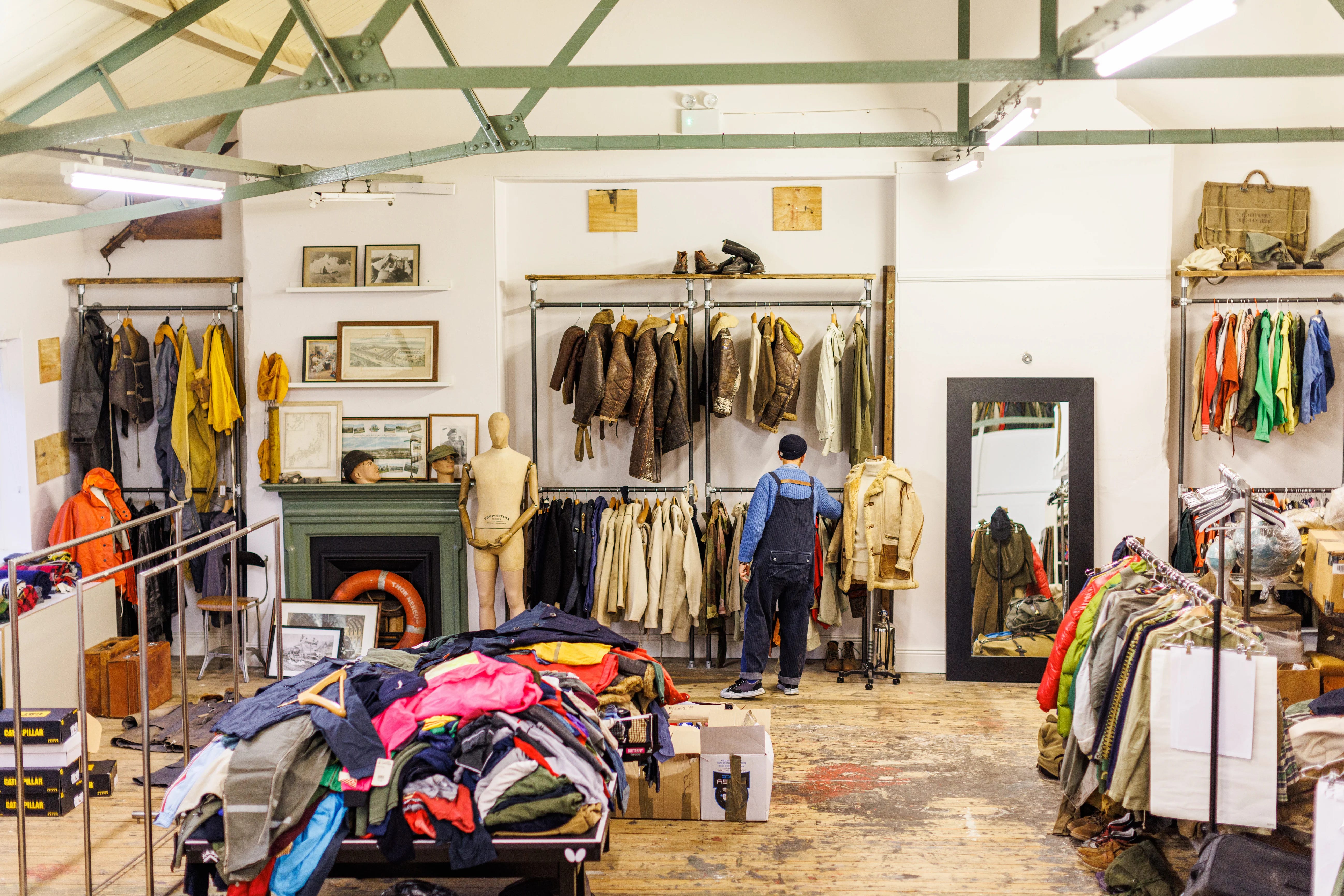
So Cabourn built a library. A real one this time, of 4,000 items of vintage clothing, and an almost equal number of books, almost exclusively drawn from the worlds of mountaineering, exploration, and the military. Nor was this particularly arid or abstract stuff. Like many of his generation, Cabourn’s grandfather was in the trenches of World War I, his father in the forests of Burma half a century later. Plus, of course, there were the tales of glorious failure that were mandatory imaginative fodder for any British boy of the time: Franklin’s doomed expedition to find the Northwest Passage; Scott’s even more doomed expedition to the Antarctic; and perhaps the most doomed of all, Mallory’s 1924 attempt to summit Everest. The plan: take all this history, and turn it into clothes.
From then on, up to four months of the year were spent scavenging for ideas, the rest on turning such scraps into new creations. The vast majority were sold in Japan, which, after an encounter with wholesaler Sam Segure in 1979, became far and away his largest market: at his time of death, he had eleven stores open in Tokyo, compared to zero in London, the city he resolutely refused to move to for the entirety of his life.
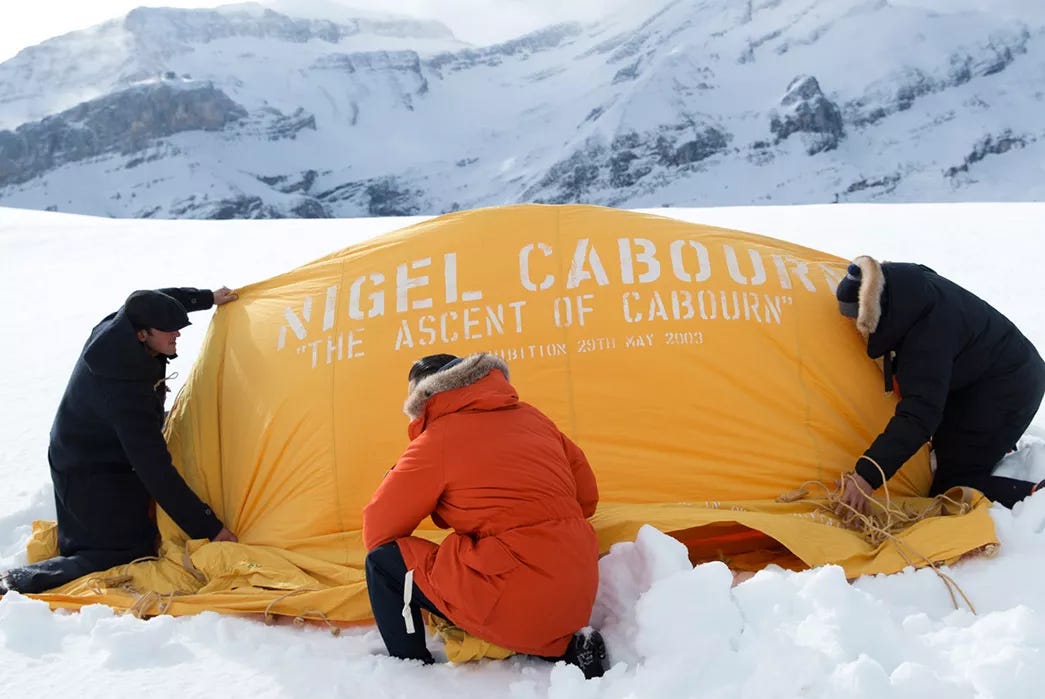
Japan was the springboard for Cabourn’s best work. There was 2003’s Ascent of Cabourn, where the designer recreated twelve items from Hillary’s Everest expedition, to sell to an eager public. There was the revival of Ventile, a niche cotton fabric developed for World War II airmen, waterproof thanks to its unusual ability to swell when wet. And there was the relaunch of Lybro, a British workwear brand from 1927 he bought and rebuilt from the ground up.
Nor was it merely the place where the dough was made. It’s also the place that helps us understand why Cabourn mattered. Japanese Americana, or Ametora (a portmanteau of American Traditional) has at its heart a central fixed point: the American story. Keep that story the same, the thinking went, and instead innovate on another axis entirely: the way the story is told. Hence the obsession with materials, methods of manufacture, garment construction. Old styles, old looms, old materials. But still America.
Yet nothing about Cabourn’s clothing felt borrowed. Tweed jackets inspired by Hillary and Mallory, Captain Scott polar parkas, or his take on the ‘Bombay Bloomers’ worn by British and Australian troops during the North Africa campaign. Nor, really, did Cabourn. One of his most enjoyable podcast interviews is with the US menswear podcast Throwing Fits (he’s introduced, excellently, as “the titan of textiles, the vintage Viking, the military maestro, the king of camo, the wizard of workwear”). Yet even James and Lawrence, who ply their trade off the back of a certain free-wheeling Dimes-Squariness, visibly struggle to adjust in the first ten minutes to the sheer velocity of Nigel’s swearing.
His approach followed a different line, taking the techniques of Americana, and applying them to another world, another country, entirely. The frontier is not that of the wide open west, but that of the late Empire: the cowboy, the lawman and the outlaw become the pilot, the soldier, and the bloke from South Shields heading off to the shipyard for a day’s rivet bolting. The Long Island scion becomes the gentleman explorer clutching a Union Jack.
There’s a romanticism at heart to all of this. Cabourn himself has admitted as such. ‘No one has ever told me I’m romantic, but I must be,’ was his response when pressed about one collection in particular, based on the relationship between Robert Capa and Gerda Taro during the 1937 Spanish Civil War. Yet isn’t all this stuff quite hard to spin romantically? It certainly came with quite the body count. Take Mallory’s first, unsuccessful expedition, in 1922, to Everest, which ended only after an avalanche (caused by Mallory himself), killed seven in their party. No worries. Two years later, back up he went.
It’s here we get to Cabourn’s second twist, one that not only distinguishes British Americana from the full-fat model, but allows two such paradoxical concepts (imagine an English cowboy!) to coexist. Lauren was always clear that when it came to Americana, you were selling a life. ‘I had my dreams of the life I want to live. My clothes were part of the dream, they were part of the world. Everyone has that little bit of that dream. They want to be that guy who’s living a certain life.’ The strategy thus followed: take the kernel of a romantic image — the hacking jacket on the saddle, or the handknitted cardigan on an Ivy League campus — and make it as romantic as one possibly could. Dial it up to eleven, until the romance is all that exists.
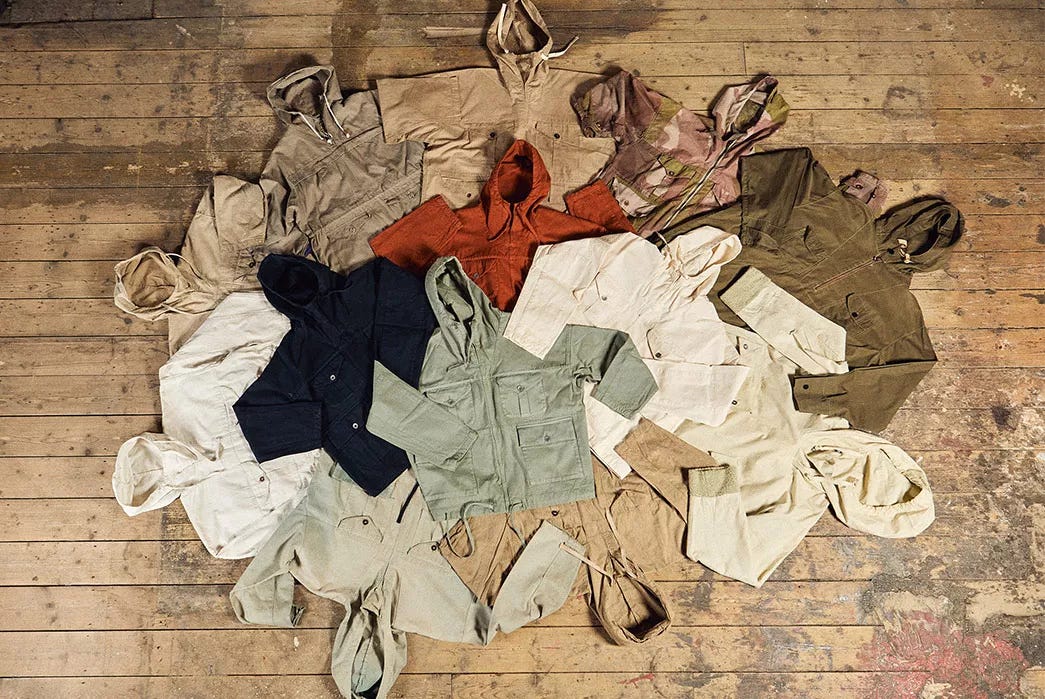
Cabourn did the opposite. Take the most heroic material twentieth century Britain has to offer, and resolutely refuse to treat it heroically. Hence the obsession with strange materials cooked up in RAF laboratories, or the pleated bellows pockets on US army jackets, designed to allow you to stuff as much ammunition in there as possible, or the ingenuity behind how the parkas and anoraks that accompanied the early polar explorers were structured: all the better to apply to kit readymade for Northumberland winters.
He respected the history, and was never glib about it, but Cabourn ultimately saw the Everest trekkers a bit like plumbers inspecting a faulty u-bend. Do I have the stuff I need? Do I have the tools for the job? Ralph sees himself like an artist, sharing notes with Paul Simon and Diane Keaton, Cabourn, the archetypical man in the shed: an engineer, or ‘very functional designer’ as he once put it. He evidently loved to tinker.
This is also what sets British Americana apart from broader ‘British heritage,’ which trades mostly on a sense of persistence over time: this jacket has always existed, it’s a thing we’ve always made — devoid of the sense of recency that naturally colours the aesthetic of a country still, by our standards, young. Instead of trading in such generalities, Cabourn was about the specific. A specific moment to invoke, a specific life to trade in, a specific function you could own.
This was often taken to absurd levels. Before launching Ascent of Cabourn he travelled to Christchurch to see Hillary’s actual parka in the flesh. Before releasing one of his staples, an homage to a classic British Officer’s shirt, the three samples were tested for durability by being placed in a normal washing machine, and having it run a hundred times in a row. During a collaboration with Peak Performance, a tester wore through the hems. Only one thing to do. Reinforce. ‘Function and quality is key to me,’ he told one magazine. ‘I want it to last forever.’ Why need heroism, when you can have logistics?
That’s not to say there isn’t a healthy dose of confection here as well. The polar parkas, the mechanic caps with comically large brims, none of it, really, is more real than a Ralph wading jacket or cowboy boot. Here’s Cabourn on Mallory: ‘I tell everybody that he went up Everest in a tweed jacket, but he didn’t really. What happened was that he kept a tweed jacket in his rucksack and whenever someone took a photo, he put it on.’ The same can be said for Ventile, which can often be treated like a sort of British wunderwaffen in cotton, ordered by Churchill personally, and capable of keeping RAF pilots toasty for hours whilst bobbing along in the Atlantic waiting patiently for a patrol boat to arrive and pick them up. Yet, like with Lauren, the confection is real. It’s there, a thing we can touch, and buy, with a creator who believes.
This was Goldberger’s answer too: his way out of the conundrum Ralph had created with his Madison Avenue tower. It was to ask a question: ‘If their buildings did not have true historical authenticity, they had another kind of honesty, the authenticity of conviction. Does Ralph Lauren’s work possess that?’ His answer was yes. The same is obviously true of Cabourn. It’s in these inauthentic authenticities that the power of both lies, making one wildly famous and deeply influential, the other, none of the former, but much of the latter.
The purest example is not the only one. Whether it’s David Keyte’s Universal Works, clothing so unfussy you can never quite shake the feeling it’s all just too busy being useful to ever pause and self-mythologise, the near-monastic devotion to construction practised by many of Britain’s more successful contemporary brands, or the intense, if very different, Britishness of everything Wales Bonner touches, it’s difficult not to see echoes of Cabourn, at varying dilutions, wherever you turn. The military jackets, cargo pants, and associated deep workwear of East London (or Tokyo) are not going to vanish overnight. British Americana will get its afterlife, comfortably.
But I do wonder if there’s something even more here? In a nation not exactly short on discomfort with its own past, a figure this at ease with the material is an outlier worthy of much closer attention. The intensity of Cabourn’s engagement, his fidelity to history, and the refusal of romance, all speak to something more. ‘I am what I do,’ Lauren told Rose. Cabourn could have said the same. And just as Ralph Lauren, undoubtedly, has a certain idea of America, Nigel Cabourn had a certain idea of Britain.
He’d probably be the first to pull us back from any of that. In one late interview he’s asked, directly, what he actually thought about the Vietnam War, and if he thought there were any political implications behind his creations. He sounds genuinely stumped — no more equipped to answer than the podcast hosts wincing three fucks into a fifteen-word sentence. A reminder, in the end of one last reality. These are just clothes, after all.