
Brick Walls
On the Minnesota Vikings, End Zone, and borrowed bodies

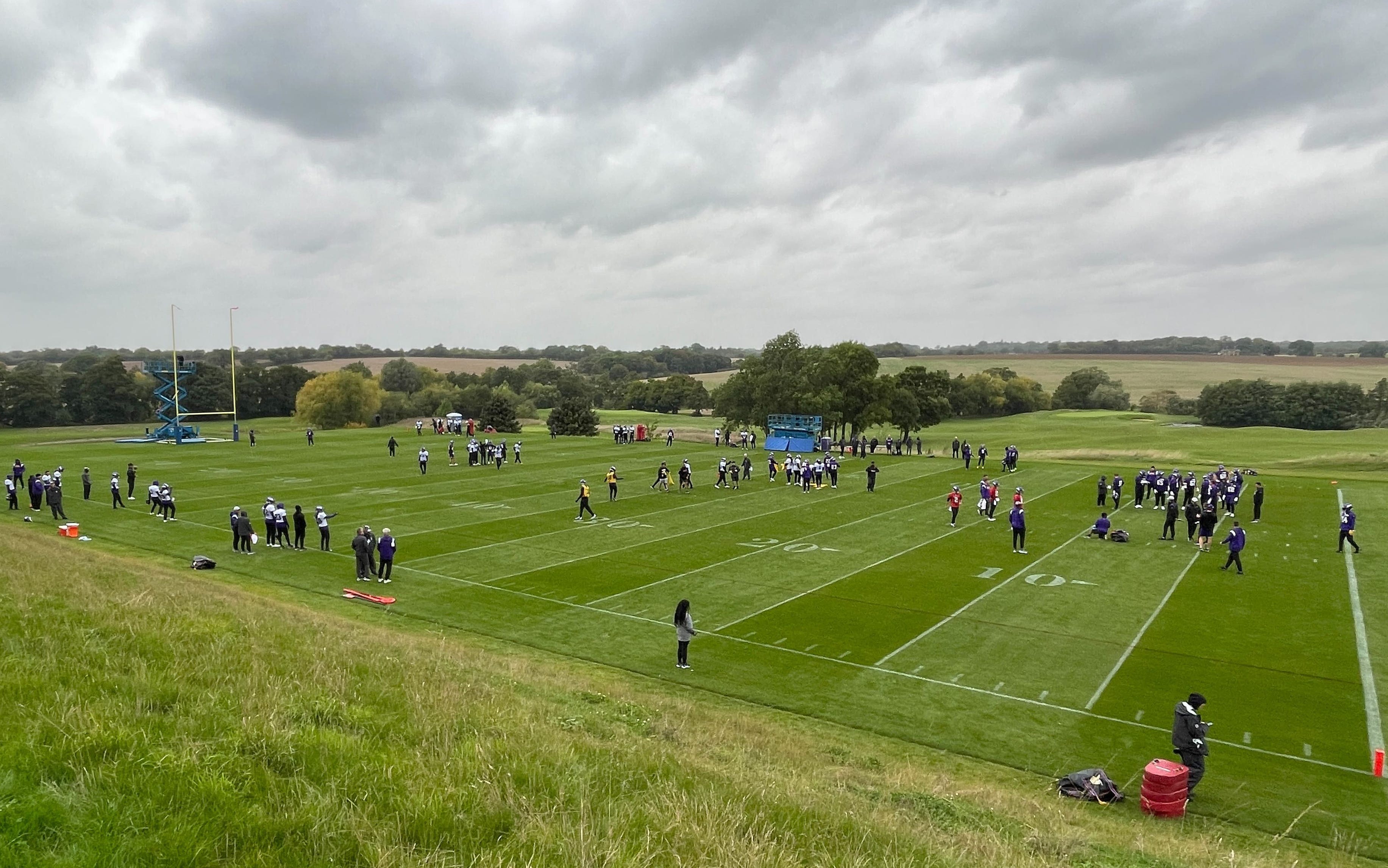
The name ’Hanbury’ keeps following me around. It’s the name of the village my wife’s family moved to ten years ago. The church where we got married. The street, on Brick Lane, that we used for our first co-working space. The pub I used to frequent, in that weird no-man’s land around Angel. The company whose East London office I’d often find myself grabbing coffee at. Now it’s back again: the Minnesota Vikings, the American football team I’ve found myself strangely involved with, are in London for their annual game. Their base, a hotel in the Hertfordshire countryside. Hanbury Manor.
The players treat the English countryside - and their adopted manor - with a mix of awe and bemusement. Strange things happen out there. Earlier this week their coach, the six-foot-five ex-quarterback Kevin O’Connell, woke to find a bird flapping around his room. The practice field, reached by a wooded path, looks out across the old Roman road to Cambridge and the north. When back-up quarterback Carson Wentz needed a haircut, he ended up driven to the nearby town of Ware, once one of England’s great malting centres.
Coming into this season, expectations were high. The Vikings had won 14 of their 17 regular-season games the year before, Kevin O’Connell named coach of the year. The faith he inspires, even from a sofa thousands of miles away, borders on awe — bolstered by the presence of Justin Jefferson, already one of the greatest wide receivers of all time. When rookie quarterback JJ McCarthy met O’Connell before the 2024 draft, he captured the vibe admirably, grabbing his hand and putting it plainly: “I’d run through a brick wall for you.” More than once over the past year, any Vikings fan watching one of O’Connell’s post-game speeches has probably found themselves glancing uneasily at their own plasterwork.
The 2025 season is the brick wall. Riven by injuries, the Vikings sit at 2–2. To an English eye that might seem middling, somewhere between Chelsea and Everton. But with only seventeen games in an NFL season, and in what is often called the league’s toughest division, the market gives them just an eight per cent chance of winning it. So, like King Alfred, they have retreated to a small corner of England, an all-American Athelney, to take stock and plan their next raid.
I suppose there’s a question I should answer: why do I care? I’m an unlikely candidate to follow such a strange, foreign sport. I grew up in Wales, in a town built around the local rugby club, so perhaps there has always been a need for contact in my life. When we first got Sky, I would catch it irregularly, usually presented by the extraordinarily likeable Kevin Cadle — a basketball coach turned Sky’s all-purpose pundit on US sports. It was on so late on Sunday nights that it felt faintly illicit, a sense that has stayed with me.
Between then and about four years ago, living life as a professional clever person, my only encounters with football were twofold. First, being vaguely annoyed when the college common room was taken over for the Super Bowl: 95% of the audience casually scrolling toward the halftime show, 5% in scratchy, oversized jerseys, fist-pumping every forty-five seconds. And second, reading Don DeLillo’s End Zone. I’ll come back to that.
A few years ago we had our first child, a profoundly atrocious sleeper. Which meant late nights pacing the living room, baby in a wrap, watching whatever was on TV. The only live sport available was American football. A few weeks later I’d chosen a team: the Vikings.
There were reasons. First, they are, like Moses, forever close to the promised land of a Super Bowl but never quite able to enter. Perfect for a Brit, raised with the Pavlovian addiction to hope that kills you. I also liked the quarterback then, Kirk Cousins — clean-cut, devout, X bio reading: “Micah 6:8: What does the Lord require of you? To act justly, love mercy & walk humbly with your God.” It was so American it was almost comical. And Minnesota, after all, feels a little like America’s Wales.
To a Brit, the game has two particular quirks. The first is how serious it is. Mao II, another DeLillo novel not about football at all, opens with the question: “When the old god leaves the world, what happens to all the expended faith?” Here it is not faith but unexpended seriousness that finds its refuge. Unlike most of life, which makes us feel we live in an unserious age where politicians, business leaders, and cultural figures no longer measure up to their predecessors, football has gone the other way. It has only become more serious.
This intellectual arms race now defines the sport. Each year the complexity and rigour increase: better-disguised coverages, shrinking time-to-throws, linemen moving faster than ever. Analysts like Mina Kimes break down games with a detail now impenetrable to casual viewers. Even Madden, the most popular American football video game, now demands that even its most casual players understand coverages as well as professionals in the 1970s. Valorisation now comes mostly from intellect. Kevin O’Connell is described as having a ‘PhD in quarterbacking,’ his defensive coordinator Brian Flores as a ‘mad scientist,’ the Kansas City Chiefs’ practice field as ‘the lab.’ KOC’s mentor, Sean McVay, is famed for remembering every play he has ever called.
This makes it, improbably, the perfect sport for a Brit to care about. Say what you like about the UK, but if there is one thing we do well, it is producing clever people. Perhaps it is even one of the best things about living here: we pathologically despise stupidity. Our national myth is built as much on boffinry as battlefield heroics: bouncing-bomb tinkerers, Enigma decoders, spooks deceiving the Nazis, as much as men stepping off Higgins boats on Sword Beach. In London, to be a taxi driver you must pass a test so difficult it literally rewires the brain.
The second quirk is its strangeness. Music, TV, and film almost always cross the Atlantic; the worlds of College GameDay, State Farm adverts, and Nick Saban do not. To travel, most culture attempts to sand down its edges, smoothing national differences into the neutral tones of an international airport. Football has done the opposite. It has stayed resolutely strange: B-2 flyovers; weeping during the national anthem; and retaining an indecipherable language, a land of cover zeros, tampa twos, and run stuffers plugging the a-gap. DeLillo again: ‘a nation is never more ridiculous than in its patriotic manifestations.’ Nothing is more ridiculous than this.
There’s a lesson here too. Culture spreads not by being universal, but by being strange. America’s most magnetic exports have always been its weirdest. The same is true of any country. Britain is only just rediscovering this: our most successful film of the year is a fever dream of native savagery and island claustrophobia, trading allusions to Saints Cuthbert and Peter with the Teletubbies and Jimmy Saville. ‘You’re all so fucking weird,’ screams the lone outsider, a Swedish soldier finally driven insane by the lumpen Brits. Moments later his head is ripped from his body.
Hence, I suppose, the sport’s total cultural domination - a monoculture that one and all can enjoy. Earlier this week, the /r/nflnoobs subreddit faced an enjoyable question: ‘ ‘just how big is the nfl “culturally” in the US?’ The top rated answer puts it plainly: ‘The NFL snatched a day of the week away from the biggest religion in the country,’ joined shortly after by another: ‘All the TVs in the ER had football on yesterday if that’s a clue.’ Even Patricia Lockwood, in her most recent LRB diary, cannot escape it, being lured down to watch the recent Super Bowl, with the promise of the half-time show: ‘IT’S HIGH ART, my husband, Jason, called up the stairs. IT’S THE STORY OF HIS LIFE. I ran down to catch the tail end of it.’
The serious and strange alone surely cannot do this? Is there something more? I think there is. Back to End Zone. Quite a common, and somewhat irksome reading of the book, is that it’s a story of how football is war. This was clearly on DeLillo’s mind whilst writing it as he explicitly gets a character to say that it isn’t: ‘I reject the notion of football as warfare. Warfare is warfare. We don’t need substitutes because we’ve got the real thing,’ after, in what most other books would be a footnote, deriding ‘the numerous commentators’ who ‘have been willing to risk death by analogy in their public discussions of the resemblance between football and war.’
So if our attraction to football, and I suppose all sports of contact, is not some Girardian martial desire, where does it come from instead? DeLillo’s answer is that it gets us the things that in the modern world, we can’t quite get elsewhere.
There’s speed: ‘the last excitement left, the one thing we haven’t used up, still naked in its potential, the mysterious black gift that thrills the millions’. Or contact: ‘the special teams collided, swarm and thud of interchangeable bodies… the breathless impact of two destructive masses, quite pretty to watch;’ Even its weight: ‘Bloomberg weighed three hundred pounds. This itself was historical. I revered his weight. It was an affirmation of humanity’s reckless potential; it went beyond legend and returned through mist to the lovely folly of history. To weigh three hundred pounds. What devout vulgarity.’
These, I suppose, are things we can only get through the body, or our bodies. And this is where he takes us: not just to the protagonist, running back hero Gary Harkness’s thoughts, but to the bodily sensations as well. When Harkness says, early on, to football Ahab Coach Creed, ‘my life meant nothing without football,’ we think it’s simply the kind of bullshit sports player espouses, dead eyed in a post-match interview. It’s only after we feel the clothes tear, the ‘glue spreading over his ribs’ after a particularly brutal encounter that we finally begin to get it.
Take such feats of embodiment for granted, and things fall apart. This most memorably happens when the 300 pound lineman, Anatole Bloomberg, decides to slim down, to disastrous results: ‘as I lost weight, as I continued to struggle against food and its temptations, I began to lose the idea of myself. I was losing the idea of my body, who it belonged to, what exactly it was, where all the different parts of it were located, what it looked like from different angles and during the various times of the day and evening. I was losing the most important part of my being.’
This, I think, today, is what draws us to sports like these: in an ever more disembodied world, those who are embodied fascinate us more and more. If the Philadelphia Eagles hadn’t won the last season, the only thing that would be remembered would be a single play, by running back Saquon Barkley, in which, seeking to escape a defender, he instead jumped, six feet up in the air, and hurdled over the head of the unsuspecting safety. Backwards. It’s the same reason why the last few films in the Mission: Impossible we no longer watch for the plot or characterisation, but simply to spend two hours with Cruise’s spectacles of skill. Is that really him? How did he do it?
The same instinct guides two releases of the last month, albeit on radically different ends of the spectrum. The first is the surprisingly cohesive Hulu series, Chad Powers, in which Glen Powell plays a Princess Diana-obsessed football pariah who decides to try to escape his psychological flaws by literally making himself a new body, and wearing it to practice each day. I’m not sure the writers knew they were channelling DeLillo when, at the end of the first episode, Powell’s character is asked why he wants to join the enjoyably named South Georgia Catfish, and replies ‘without football, I don’t know who I am,’ but there we are.
The second is the single best study of embodiment I’ve read for a while, Jordan Castro’s recently released novel, Muscle Man. Castro’s protagonist, Harold, is a professor of English literature at a liberal arts college. Harold wants out, and so he takes up lifting. In Hill’s Health World, his shining gym on the hill, he engages in his battle against the disembodied mind of the academy. Like Coach Creed, he too is an Ahab of embodiment, Merleau-Ponty with trapezoids, chasing a true ‘mind-muscle connection.’
In his best moments at the gym, everything changes: his body opens up, colours seem more vivid, the life he’s trying to leave behind just a shade more distant. ‘The body ached and screamed, but it also spoke and sang. The body had its own way of thinking. Harold was beginning to learn its language.’ This too is phenomenology applied. Embodiment for men, right alongside Saquon’s highlight reels. At moments, lifting even transcends the intellectual and becomes spiritual: ‘Sitting up from underneath the bar, he felt reborn.’ I’m reminded even of Corinthians: ‘the body that is sown is perishable, it is raised imperishable; it is sown in dishonour, it is raised in glory; it is sown in weakness, it is raised in power; it is sown a natural body, it is raised a spiritual body.’
Contrast such spiritual bodies, as Castro does, with Harold’s co-workers, brains in vats, with arms that ‘more closely resemble a spaghetti noodle than an actual human arm.’ Understandably, their greatest ire is turned towards the campus football players, hoovering up their budgets, whilst being all being so damn happy all the time: ‘the football players fought back against the deadening more than any other student group on campus, essentially because they loved football. This love structured their lives so that they regularly failed to do their homework, and this was in the end what saved them.’
It’s easy to see why such figures obsess us, for good or bad. While most work becomes easier, more abstracted, less embodied, the work of the athlete does the opposite. When things seem dumber, some sports, at least, appear to get harder. Such seriousness is contagious. When Timothée Chalamet reached for the language of greatness in a recent awards speech, he reached for the only language left: that of sport. ‘The truth is I’m really in pursuit of greatness. I know people don’t usually talk like that. But I want to be one of the greats.’
Agree, or not, it’s difficult to look away. The players of Hanbury might not realise this is what they’re doing, but maybe they do. When JJ McCarthy stood up and told Kevin O’Connell he was going to run through a brick wall through him he probably didn’t know he was quoting DeLillo directly, or more accurately, Bobby Luke, one of Harkness’s colleagues, ‘famous for saying he would go through a brick wall for Coach Creed.’
Indeed, after a quick search, bar a few mentions in regional newspapers, it does seem that the first time anyone actually wrote down the phrase, presumably at that time already circling around the college and professional football communities - ‘to run through a brick wall,’ - was DeLillo in End Zone. To run at a brick wall, or to bang one’s head against it, had been around for a long time, since the 17th century at least. But to run through such a wall, and to use one’s own body to do so, it turns out is a relatively newer invention. We needed sports to get us there.
Which is why, when Justin Jefferson runs so far, or JJ McCarthy vows to run through that wall for his coach, we can’t help but follow. Not for seriousness, or strangeness, or even entertainment. But for embodiment, borrowed for a moment as our own.